

DOrSU Weaves Peace and Conflict Studies into Soc Sci 11
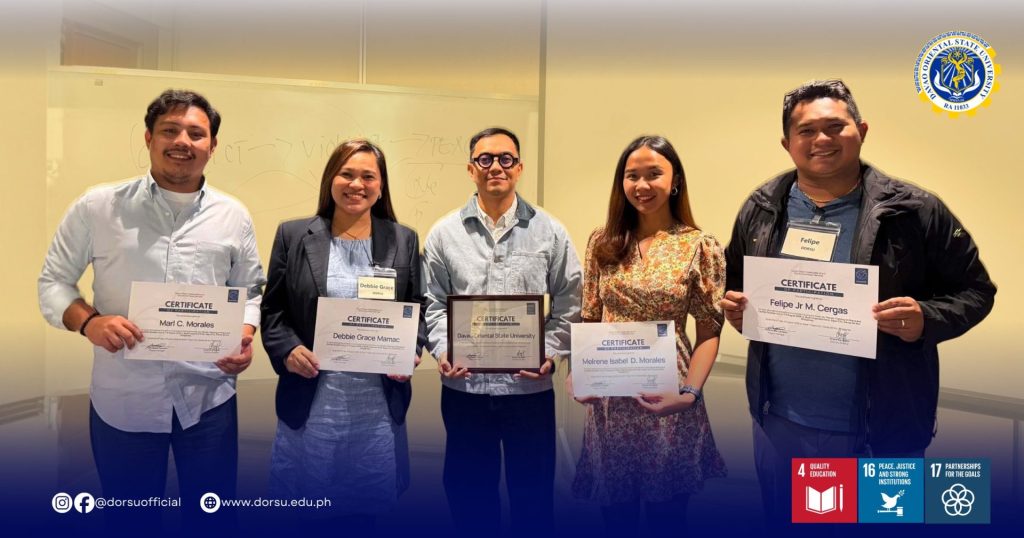
Peace and conflict will be taken up more deliberately in Davao Oriental State University (DOrSU) classrooms as DOrSU adopts the Peace and Conflict Studies (PCS) syllabus and learning modules for Soc Sci 11 (Peace, Development, and Indigenous Communities).
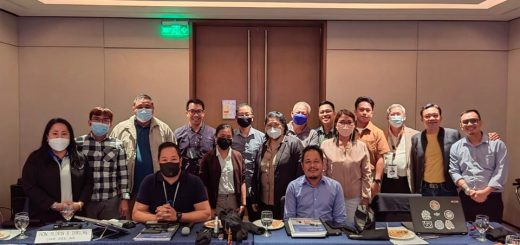
Ahead of the rollout, five faculty members handling Soc Sci 11 joined a three-day Faculty Development Training on Peace and Conflict Studies on August 7–9 in Digos City, Davao del Sur.
The DOrSU contingent was composed of Mark Aljen D. Binocal, Melrene Isabel D. Morales, Debbie Grace Mamac, Felipe Jr. M. Cergas, and Marl Morales.
The training prepared faculty members to work with the PCS syllabus and learning guides not simply as additional course content, but as materials that call for a particular way of handling conversations on peace and conflict in the classroom. Sessions emphasized dialogue, critical reflection, and sensitivity to the different experiences and contexts that students bring into discussions.
The approach is especially relevant to Soc Sci 11, where questions of peace and development are examined alongside the experiences, concerns, and place of indigenous communities.
The syllabus and learning materials were developed pursuant to CHED Memorandum Order No. 1, series of 2019, which provides for the integration of Peace and Conflict Studies in higher education institutions in Mindanao. The initiative covers syllabus and learning guide development, faculty training, and the piloting of PCS in participating universities and colleges.
For DOrSU, the adoption also finds a place within its regenerative futures vision. Regeneration, as pursued by the University, extends beyond restoring ecosystems. It also means helping build communities capable of sustaining just relationships, navigating differences, and creating conditions in which people and places can thrive together. Seen in this light, peace education becomes part of the University’s larger work of preparing students to contribute to communities that are not only resilient, but also inclusive, reflective, and capable of addressing conflict constructively.
The August training was organized by forumZFD Philippines, a German non-government organization and a continuing partner of DOrSU in efforts to mainstream peace and conflict studies and conflict-sensitive journalism.
The engagement adds another dimension to that partnership. While previous initiatives have helped strengthen conflict-sensitive approaches to communication, the integration of PCS into Soc Sci 11 takes the work directly into the classroom, where students can examine peace, conflict, development, and community life as interconnected concerns.
The direction also reflects a basic premise of the PCS program: peace cannot simply be taught as a set of concepts. It must also be practiced in the way people listen, question assumptions, understand competing perspectives, and engage with difficult issues.
For more than 30 years, forumZFD has worked with civil society actors and other partners toward peaceful and nonviolent approaches to conflict. It currently works in 13 countries across Europe, the Middle East, and Southeast Asia.