

DOrSU secures ₱14M for marine wildlife conservation in Davao Oriental
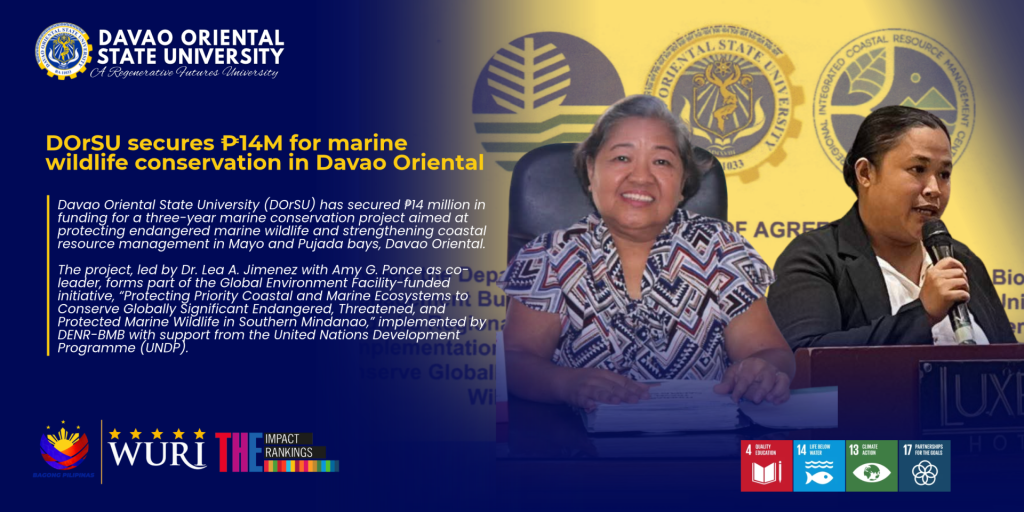
Davao Oriental State University (DOrSU) has secured ₱14 million in funding for a three-year marine conservation project aimed at protecting endangered marine wildlife and strengthening coastal resource management in Mayo and Pujada bays, Davao Oriental.
The project, led by Dr. Lea A. Jimenez with Amy G. Ponce as co-leader, forms part of the Global Environment Facility-funded initiative, “Protecting Priority Coastal and Marine Ecosystems to Conserve Globally Significant Endangered, Threatened, and Protected Marine Wildlife in Southern Mindanao,” implemented by DENR-BMB with support from the United Nations Development Programme (UNDP).
The funding was formalized through a memorandum of agreement signed on October 15, 2026, between DOrSU and the Department of Environment and Natural Resources–Biodiversity Management Bureau (DENR-BMB).
Running from 2026 to 2028, the DOrSU-led undertaking will focus on assessing marine biodiversity, mapping critical habitats, evaluating climate-related risks, and developing conservation and management plans for Mayo and Pujada bays.
The project will also support the development of marine protected area networks, strengthen the technical capacities of coastal resource managers, and involve fishing communities, tourism operators, and other stakeholders in conservation efforts.
Both bays form part of a wider conservation initiative targeting threatened marine species, including dugongs, marine turtles, and cetaceans, as well as vital coastal habitats such as coral reefs, seagrass beds, and mangrove forests.
The undertaking draws on DOrSU’s established expertise in marine science and coastal resource management through its Regional Integrated Coastal Resource Management Center XI, University Marine Science Research Laboratory, and participating academic units.
Dr. Jimenez, who previously served as director of RIC XI, has led numerous studies and conservation initiatives involving marine biodiversity, coastal ecosystems, and community-based resource management.
The project is expected to provide scientific data and practical management tools to help government agencies and coastal communities improve marine biodiversity protection while supporting sustainable fisheries and coastal livelihoods.