

Polish Researcher Leads DOrSU Workshop on AI-Assisted Academic Research
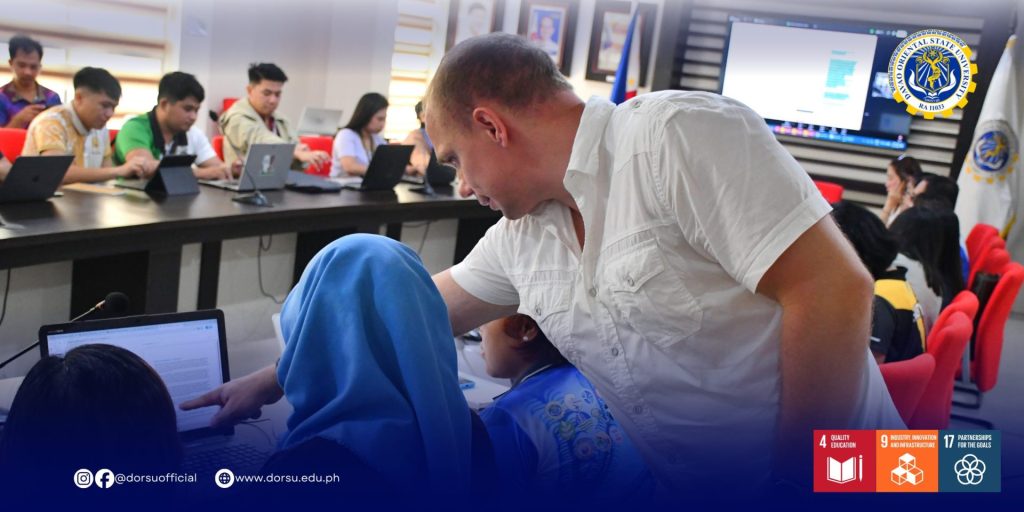
Polish researcher Dr. Pawel Frankowski of the Maritime University of Szczecin, Poland, led Davao Oriental State University (DOrSU) faculty members and researchers through the responsible use of artificial intelligence in academic research during a workshop held on August 13 at the University Boardroom.
Titled “A Workshop on AI Tools for Academic Research Rigor,” the session tackled how researchers can use large language models (LLMs), including ChatGPT and Gemini, to make literature reviews and other research processes more efficient without compromising the accuracy, credibility, and scientific rigor expected of scholarly work.
A major focus of the workshop was one of the persistent challenges in using generative AI for research—AI hallucinations, or information generated by AI that may be inaccurate, fabricated, or unsupported by reliable sources.
Dr. Frankowski discussed ways of critically examining and verifying AI-generated information, particularly when using AI for systematic literature reviews, knowledge filtering, literature searching, and research paper preparation. Participants also took part in a hands-on session that allowed them to explore how AI tools can be incorporated into actual research workflows.
The workshop placed particular emphasis on using AI as an aid rather than a substitute for scholarly judgment, with researchers remaining responsible for evaluating sources, checking information, and ensuring that research outputs meet established academic and methodological standards.
DOrSU President Dr. Roy G. Ponce, in his message, underscored the need for researchers to approach rapidly evolving AI technologies with both openness and critical judgment.
“Usually, the results of our prompts offer answers that are out of place or inaccurate, which we term as AI hallucinations. Because of this, we are not really sure whether the information generated through our interaction with AI can be rigorously used in academic papers,” Dr. Ponce said.
He also pointed to the role of younger researchers in strengthening AI literacy within the University, noting that their growing familiarity with emerging technologies could enable them to help colleagues navigate new research tools and practices.
Vice President for Research, Innovation, and Extension Dr. Emily S. Antonio also delivered a message during the activity, while COIL Coordinator Sheena Michelle Badayon gave the opening remarks. Director for Research Dr. Jonathan S. Cabrera closed the program.
Organized by DOrSU’s Global Affairs and International Relations Office (GAIRO), in collaboration with the Office of the Vice President for Research, Innovation and Extension, the workshop forms part of the University’s efforts to develop researchers who can make productive and responsible use of emerging technologies.
The August 13 workshop is the first in a series of engagements with Dr. Frankowski at DOrSU. Succeeding sessions are scheduled for the University’s information technology faculty on August 27 and graduate students on August 29. He is also expected to return as an international speaker during activities related to DOrSU’s International Biodiversity Conference in October.
Through the engagement, DOrSU continues to strengthen AI literacy alongside research capability and international academic collaboration—placing greater emphasis not simply on adopting new technologies, but on using them critically, ethically, and with the rigor demanded of academic research.