


DOrSU inks partnerships on permaculture, poultry sustainability research
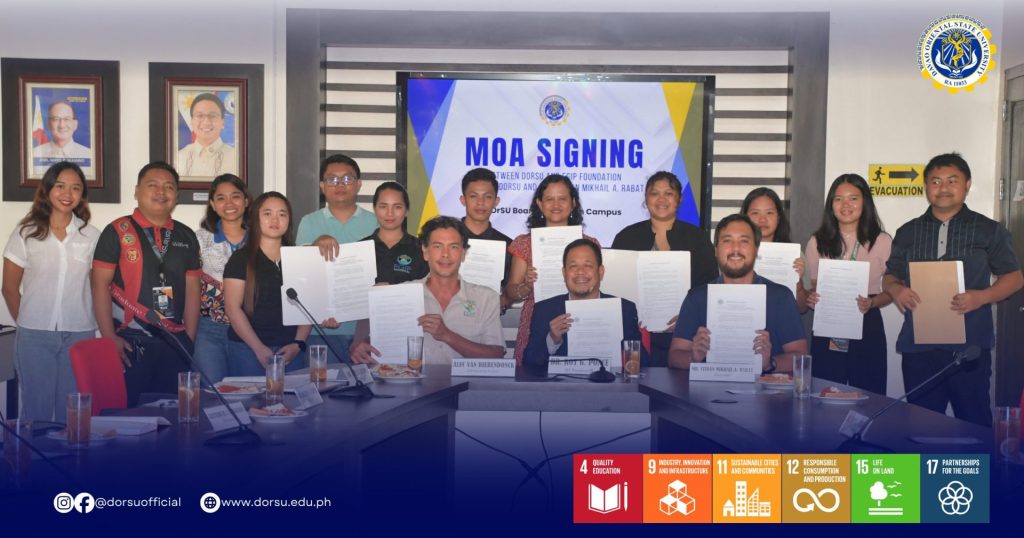
Davao Oriental State University signed two agreements on June 30, at the University Boardroom, DOrSU Main Campus, opening new partnerships on permaculture development and poultry sustainability research.
The agreements were signed with EGIP Foundation, Inc. for the establishment of an Arboretum Permaculture project and with Mr. Stefan Mikhail A. Rabat for a study on sustainable and regenerative approaches to reduce odor emission and fly population in commercial poultry production systems.
DOrSU President Dr. Roy G. Ponce said the partnerships form part of the University’s effort to bring its regenerative futures direction into concrete research and community-based work.
“What we are trying to do now is to create a network of partners in really materializing our regenerative futures agenda. That’s our niche and brand,” Ponce said. “We cannot have true human development if we degrade the other. There’s really no future if we destroy our home.”
Under the agreement with EGIP Foundation, DOrSU will provide a project site within the University and mobilize faculty, researchers, and support personnel for site assessment, project design, implementation, monitoring, and documentation. EGIP Foundation will provide financial and technical support, including materials, seedlings, tools, and equipment for the permaculture and restoration activities.
EGIP Foundation President Alec van Dierendonck said the collaboration is anchored on a shared commitment to conservation, environmental regeneration, and support for communities that depend on natural resources.
“We are very happy that we both have that same vision,” van Dierendonck said, adding that environmental work must also consider the needs of communities on the ground.
The second agreement will allow DOrSU and Rabat to pursue a research project that will develop, implement, monitor, and evaluate sustainable and regenerative measures for poultry production, particularly in reducing odor and controlling fly population. The project will involve scientific studies, technical assessments, stakeholder engagement, and knowledge-sharing activities in support of sustainable poultry management.
Ponce said the poultry research reflects the University’s interest in science-based, nature-responsive solutions to local concerns.
“We are looking at possible natural solutions for reducing the effect of poultry farming, using scientific approach on reducing odor and flies,” he said.
A major output of the poultry sustainability project is a Final Technical Evaluation Report to be prepared by DOrSU. The report will document the methodology, data, findings, and measurable results of the interventions, including odor reduction, fly population control, and environmental impact. A copy will also be furnished to the City Government of Mati as technical input for local planning, including the formulation and enhancement of its Comprehensive Land Use Plan.
Rabat, who cited previous collaborations with the University, expressed gratitude and optimism over the new agreement.
“This is just another step in our continuing partnership,” Rabat said. “I’m sure this is not the last time.”
For DOrSU, the twin partnerships add to its growing work in applied research, environmental protection, sustainable agriculture, and community development.
“We need a network of people, leaders, industries of the same mind,” Ponce said. “That’s the assignment of the University.”