


DOrSU capacitates Mati child development workers on play-based learning
Davao Oriental State University capacitated 56 Child Development Workers from the City Social Welfare and Development Office of Mati City on May 21, 2026, through a training on inclusive and play-based early childhood learning.
The capacity-building activity aimed to equip the participants with practical skills in designing developmentally appropriate learning environments for young children, especially through play-based strategies.
The initiative supports the United Nations Sustainable Development Goal 4, or Quality Education, by promoting inclusive, equitable, and meaningful learning opportunities in early childhood education. It also aligns with DOrSU’s Regenerative Futures Initiative, championed by University President Dr. Roy G. Ponce, which underscores the university’s commitment to community empowerment, sustainability, and transformative education.
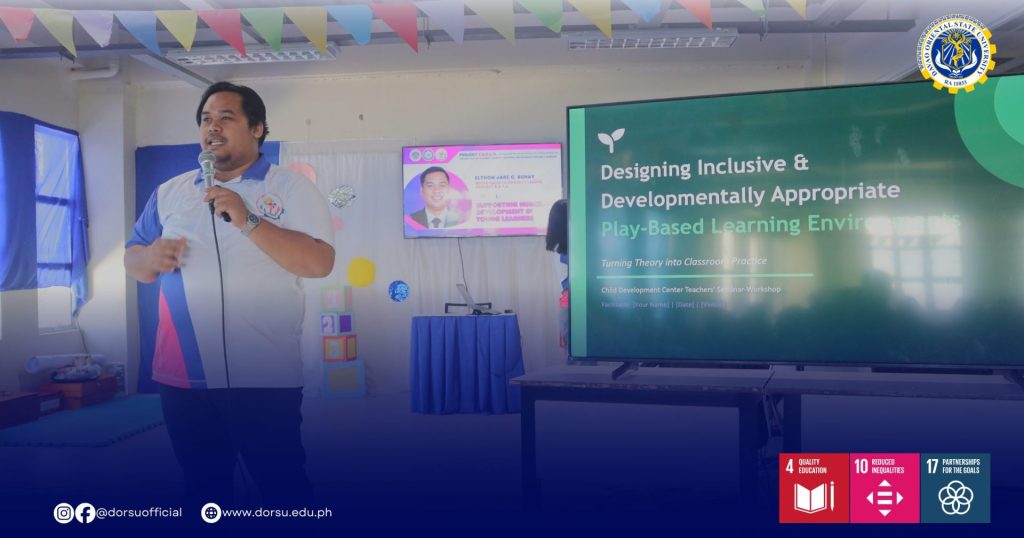
Elthon Jake C. Buhay, LPT, faculty member of the Bachelor of Early Childhood Education (BECEd) program and project leader of Project B.A.T.A., served as resource speaker for the topic, “Designing Inclusive and Developmentally Appropriate Play-Based Learning Environments.”
Meanwhile, Crispey B. Capundag, National Child Development Center (NCDC) and DOrSU Preschool Department Administrator, facilitated a hands-on workshop on creating play-based learning activities using local and recycled materials.
During the sessions, participants learned how simple and available resources can be transformed into meaningful learning tools that encourage creativity, communication, social interaction, and active participation among children.
The training also gave the child development workers a space to ask questions, share classroom experiences, and reflect on their role in supporting the growth and development of young learners in their respective centers.
Project B.A.T.A. is a component of Project TUDLO, the BECEd program’s extension initiative designed to strengthen the capabilities of child development teachers and workers through responsive training, seminars, and workshops.