

DOrSU faculty researchers present studies to support evidence-based policies in Mati
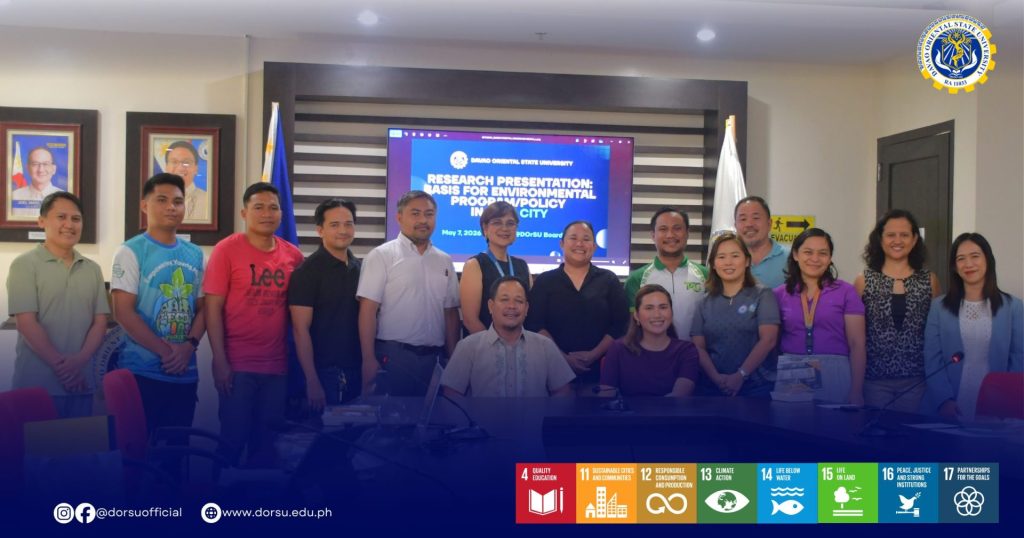
Davao Oriental State University (DOrSU) presented research studies conducted by its faculty researchers to support the formulation of evidence-based policies in the City of Mati on May 7 at the University Board Room.
Attended by City Councilor Tara Rabat Gayta, Chair of the Sangguniang Panlungsod Committee on Environmental Protection; City Environment and Natural Resources Office (City ENRO) Department Head Jovelyn P. Lugo; and other City ENRO personnel, the session provided DOrSU researchers a venue to share scientific findings and policy recommendations that may inform local policy development, particularly in environmental protection, biodiversity conservation, waste management, land-use planning, and sustainable community development.
Among the studies and policy briefs presented were “SOS Marine Wildlife: A Strategic Blueprint for Megafauna Protection in Davao Oriental” and the policy brief on mainstreaming the Eastern Mindanao Biodiversity Corridor (EMBC) Biodiversity Conservation Plan into local governance, land-use planning, investments, and conservation programs, both presented by Amy G. Ponce; “Microplastics, Macro-Solutions: Policy Imperatives to Strengthen Plastic Waste Management for Pujada Bay,” presented by Dr. Ricksterlie Verzosa; “M2P2: SAAD — Macro- and Micro-Plastic Pollution Science, Advocacy, Action, and Direction,” presented by Dr. Emily S. Antonio; “Perceptions of Food Vendors on the Proposed Single-Use Plastic Ban in Davao Oriental,” presented by Dr. Helina Jean P. Dupa; “Ethnobiological Knowledge and Conservation of Seagrass Ecosystems in the Philippines,” presented by Marielle Thery A. Jumawan; and “Understanding Marine Plastic Pollution in Davao Gulf through Seasonal Drift Modeling and Data-Driven Waste Management Strategies,” presented by Dr. Jonathan S. Cabrera.
In his message, DOrSU President Dr. Roy G. Ponce expressed hope that the City of Mati, through Councilor Gayta’s committee, would consider adopting the university’s regenerative futures philosophy in shaping local environmental policies and programs.
Dr. Ponce said regenerative futures is the niche and institutional branding that guides the university’s direction, anchored on the principle of regeneration as opposed to degradation and destruction.
“The academic community is in a constant quest. We continue to learn and study how to strike a balance among the environment, human well-being, the economy, technology and digital transformation, and social development,” Dr. Ponce said.
He emphasized that these components must work together to regenerate communities and ecosystems, adding that such balance must be continuously studied through diligent research.
“Governance is an important part. DOrSU will always be here to support the city’s environmental programs,” he added.
Councilor Gayta expressed her gratitude to DOrSU for its continued openness to collaboration, noting that the university’s research outputs are valuable in crafting policies that are both evidence-based and impactful.
She also underscored the importance of tapping academic expertise in local governance, particularly in developing environmental measures that respond to the actual needs and conditions of the city.
The engagement reflects DOrSU’s continuing commitment to strengthen university-government collaboration by translating research into practical inputs for public policy, environmental stewardship, and sustainable local development.