

University President Ponce highlights DOrSU’s reef restoration initiatives at Davao Dive Summit 2026
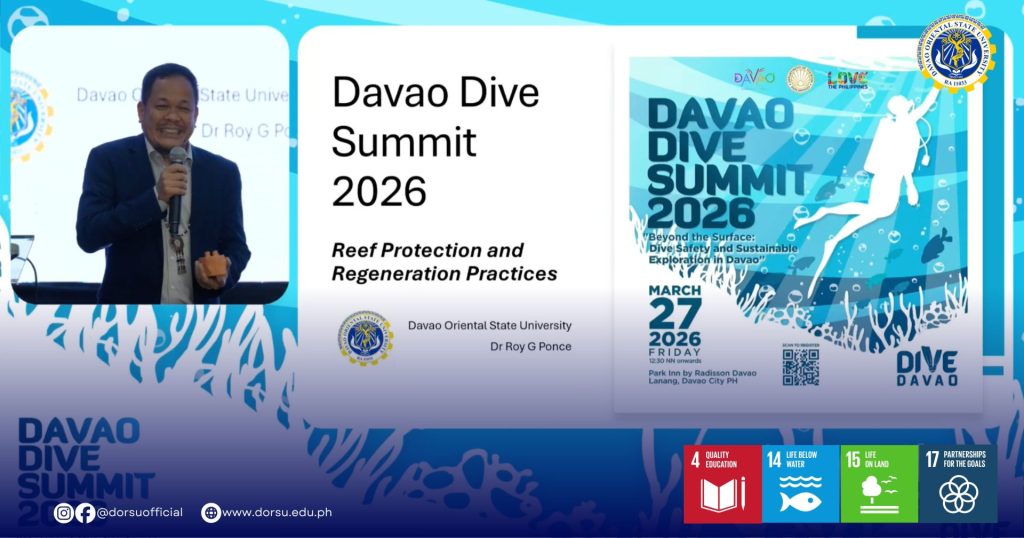
Academe-led reef restoration efforts gained attention at the Davao Dive Summit 2026 as Davao Oriental State University (DOrSU) President Dr. Roy G. Ponce presented the university’s flagship marine conservation initiatives
As one of the summit’s resource speakers, Dr. Ponce featured DOrSU’s coral reef regeneration project using 3D eco-engineered clay reef modules, its plastic-use education program, and the university’s contribution to the inclusion of Pujada Bay in the UNESCO World Heritage Tentative List as an extension of the Mt. Hamiguitan Range Wildlife Sanctuary. He emphasized that these initiatives are anchored on the university’s institutional ethos of Regenerative Futures.
“DOrSU is pushing for this ethos,” Dr. Ponce said. “We believe that nature, communities, economy, and knowledge—such as research, technology, digital transformation— can all thrive together in a balance.”
Among the projects highlighted was DOrSU’s coral reef regeneration initiative using 3D eco-engineered clay reef modules, implemented in partnership with rrreefs, with the support of other local and international collaborators. The project, launched in Pujada Bay in February 2024, involved the rebuilding of a 100-square-meter reef habitat using over 820 3D-printed terracotta modules designed to catalyze coral recruitment and foster reef biodiversity. Simultaneously, around 9,000 mangrove seedlings were planted along the coastline by the Mama Earth Foundation.
Dr. Ponce shared that the project has already shown measurable ecological gains. Based on the project updates, about 80 percent of the bricks became home to mobile invertebrates within the first five months. After one year, the structure was estimated to host more than 4,000 coral recruits, while coral recruit density increased from 13 to 34 recruits per square meter. The mean observed size of young corals likewise rose from 20.5 mm after five months to 52.6 mm after one year, reflecting 157 percent coral growth in seven months.
He also reported strong fish recovery in the site. Within the first months of deployment, the artificial reef recorded a 10-fold increase in fish biomass compared with the control site. The reef also persistently supported higher species richness and functional diversity, with 45 species documented on the artificial coral reef compared with 22 at the control site.
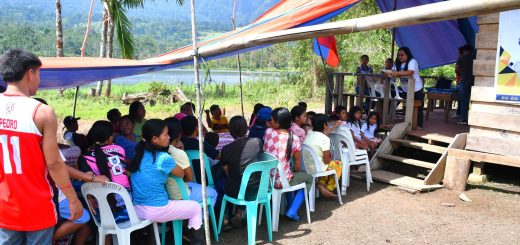
Dr. Ponce also talked about DOrSU’s plastic-use education and community intervention on ocean plastic debris, an initiative that complements the university’s broader research and extension work on marine pollution. He shared that the program has already been replicated in at least six sites in Mati City and in the province of Davao Oriental, and that communities interested in adopting it are welcome to do so.
“Our goal is to raise a cohort of children who are conscious about plastics,” he said, emphasizing the importance of micro-lectures in the implementation of the program.
Related to this, Dr. Ponce also spotlighted DOrSU’s Macro- and Micro-plastic Pollution Research Program, funded by the Commission on Higher Education, which recently advanced as a finalist in the Times Higher Education Awards Asia 2026. The program qualified among eight finalists out of more than 500 entries, marking another significant international recognition for the university.
He likewise presented the initiative on Pujada Bay as an extension of the Mt. Hamiguitan UNESCO World Heritage Site and called for stronger collaboration in protecting interconnected coastal and marine ecosystems.
Dr. Ponce expressed gratitude to DOrSU’s partners for supporting the university’s marine conservation work, underscoring that reef regeneration is strengthened through collaboration among academe, communities, development partners, and government institutions.
Organized by the Department of Tourism–Davao Region, the Davao Dive Summit 2026 gathered stakeholders to share knowledge, best practices, and innovations in dive safety, marine conservation, and sustainable tourism. Through its participation, DOrSU reaffirmed its role in advancing science-based and community-linked approaches to reef restoration and marine ecosystem conservation.