


DOrSU starts three-day training on New Government Procurement Act
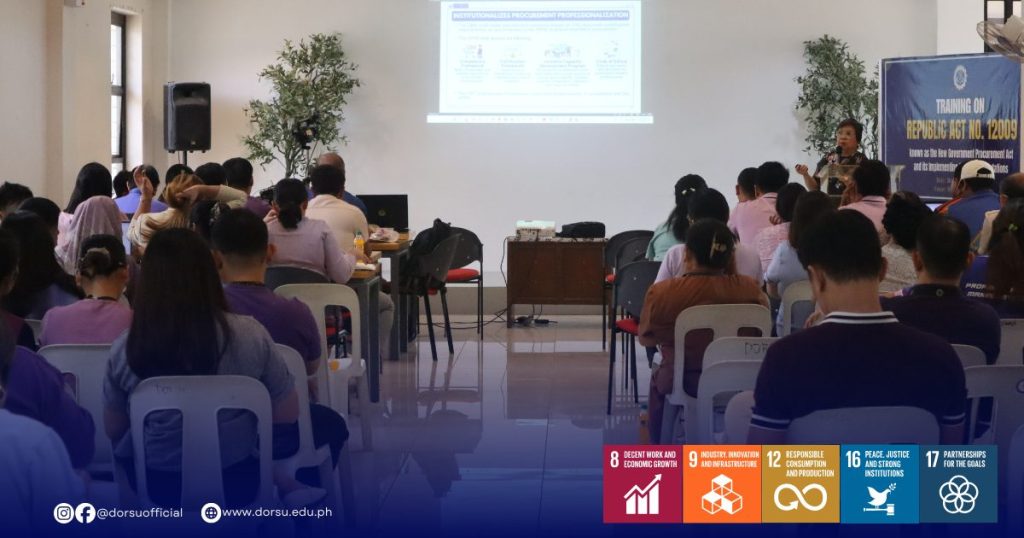
Davao Oriental State University commenced its three-day training on Republic Act No. 12009, or the New Government Procurement Act, and its Implementing Rules and Regulations on March 18 at the DOrSU Main Campus, with the Procurement Management Office leading the activity.
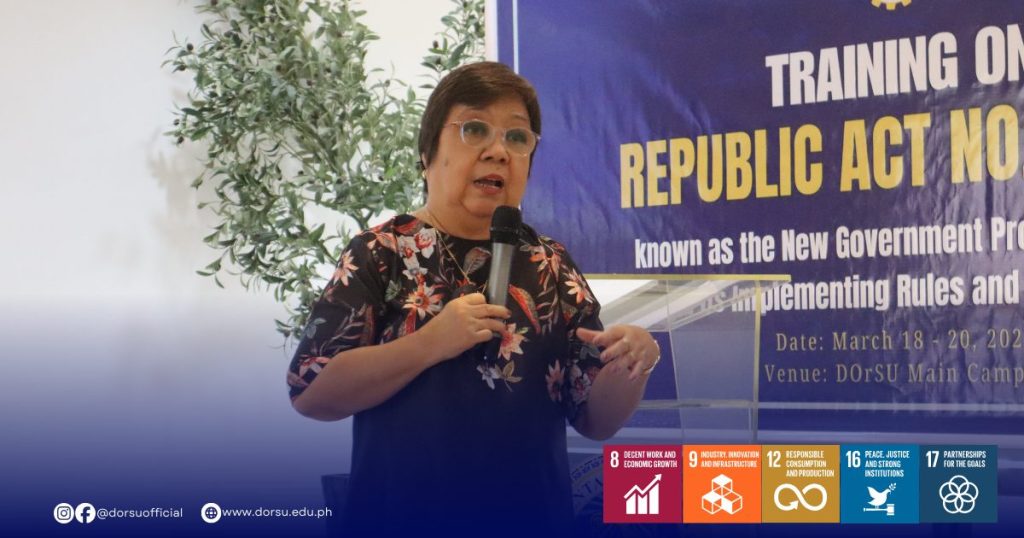
Serving as resource speaker on the opening day was Ms. Noemi P. Wong, MBA, CPA, an Accredited Government Procurement Policy Board (GPPB) Trainer, who discussed the law’s expanded scope and strategic, technology-driven procurement reforms.
In the learning session, Wong outlined key provisions of the law, stressing that procurement applies regardless of funding source, including foreign-assisted projects. She explained that treaties and international agreements may prevail over the Implementing Rules and Regulations (IRR), while the IRR governs when such agreements are silent.
Wong also identified exclusions, including foreign grant-funded procurement unless otherwise agreed upon, acquisition of real property under Republic Act No. 10752, and public-private partnership projects under Republic Act No. 6957, as amended by Republic Act No. 7718. She added that activities such as direct assistance, trainings, job order and contract of service engagement, and disposal of government assets are not covered by the law.
She said agencies may continue procurement activities while awaiting updated guidelines, provided existing procedures remain in force. Adjustments, she noted, are expected once new guidelines are issued.
Wong highlighted reforms in strategic procurement planning, including mandatory market scoping, risk management, and a whole life cycle approach covering acquisition to disposal. She also cited supply positioning and the “fit-for-purpose” principle in aligning procurement with actual needs.
“Procurement should be planned based on what is necessary and appropriate for the intended use,” Wong said.
The law also introduces modernization measures, including end-to-end electronic procurement, integration of agency databases, enhancements to PhilGEPS, electronic payment systems, and procurement data analytics to support oversight and detect irregularities. Transparency mechanisms such as mandatory video recording and livestreaming of bidding activities were also discussed.
Wong further cited the design-and-build scheme for infrastructure projects, where a single contractor handles both design and construction, as a measure to streamline processes and speed up implementation.
The session forms part of ongoing efforts to guide agencies in implementing RA 12009.